Blog
February 25, 2026
Artificial Intelligence (AI) is no longer a futuristic vision confined to science fiction—it is the defining technology of the 21st century. From reshaping global economies to redefining how individuals live, work, and communicate, AI has emerged as a powerful catalyst for transformation. According to global projections by PwC, AI is expected to contribute over $15 trillion to the world economy by 2030. This unprecedented impact signals not just technological advancement, but a fundamental shift in productivity, innovation, and competitiveness worldwide.
India, one of the fastest-growing digital economies, is rapidly embracing this transformation. With strong government backing, a vibrant startup ecosystem, and a growing digital infrastructure, AI adoption across India is accelerating at an impressive pace.
The Rise of AI in India
India’s AI journey is closely aligned with national digital initiatives such as Digital India and the National Strategy for Artificial Intelligence introduced by NITI Aayog. These initiatives aim to position India as a global AI hub by promoting research, encouraging startups, strengthening data ecosystems, and enabling public-sector innovation.
According to industry estimates by NASSCOM, India’s AI market is expected to reach $7–8 billion by 2025. This growth is fueled by increasing enterprise adoption, government support, and the availability of skilled technology professionals.
India’s AI landscape is unique because of its scale. With over a billion citizens and diverse socio-economic conditions, AI solutions in India are often designed to solve large-scale challenges—healthcare accessibility, agricultural productivity, financial inclusion, and multilingual communication.
🏭 Industry Transformation Through AI
AI is revolutionizing industries by improving efficiency, accuracy, and decision-making. Its integration into core business processes is creating smarter systems that reduce costs and increase output.
🏥 1. Healthcare: Smarter Diagnosis and Better Outcomes
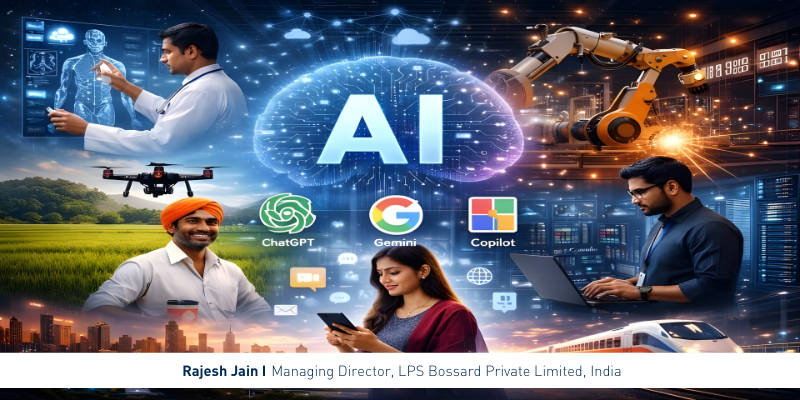
In healthcare, AI-powered diagnostic systems are assisting doctors in detecting diseases such as cancer, tuberculosis, and diabetic retinopathy with improved precision. Machine learning algorithms analyze medical images, patient records, and genetic data to identify patterns that may be difficult for humans to detect.
In India, AI is playing a crucial role in bridging healthcare gaps in rural areas. Telemedicine platforms integrated with AI tools help deliver faster preliminary diagnoses and remote monitoring. Globally, AI is being used in drug discovery, robotic surgeries, and predictive analytics to forecast disease outbreaks.
The COVID-19 pandemic further accelerated AI adoption in healthcare, highlighting the importance of data-driven systems for managing large-scale health crises.
🏭 2. Manufacturing: The Era of Smart Factories
Manufacturing industries worldwide are undergoing a transformation driven by AI and Industry 4.0 technologies. Smart factories use AI-powered predictive maintenance systems to anticipate machine failures before they occur, reducing downtime and operational costs.
Robotics integrated with AI enhances precision and speed in assembly lines. Computer vision systems inspect products for defects, ensuring quality control at scale. In India, manufacturing hubs are increasingly investing in automation to remain globally competitive.
AI also enables supply chain optimization by forecasting demand, tracking shipments, and minimizing inventory losses.
🌾 3. Agriculture: Feeding the Future
Agriculture remains a backbone of India’s economy, employing a significant portion of the population. AI is empowering farmers with data-driven insights on weather forecasting, soil health, crop diseases, and yield prediction.
Drone-based imaging, satellite data, and AI-powered analytics platforms help monitor crop health and suggest optimal irrigation and fertilization strategies. These technologies improve productivity while conserving water and resources.
Globally, precision farming powered by AI is transforming food production, making it more sustainable and resilient to climate change.
💳 4. Banking and Finance: Secure and Intelligent Systems
The financial sector is one of the earliest adopters of AI. Banks and financial institutions use AI for fraud detection, risk assessment, customer segmentation, and algorithmic trading.
AI-powered chatbots enhance customer service by providing 24/7 assistance. In India’s rapidly expanding digital payments ecosystem, AI strengthens cybersecurity frameworks, reducing fraud and ensuring secure transactions.
By analyzing massive volumes of financial data in real time, AI enables smarter lending decisions and improves credit accessibility for underserved populations.
✨ Generative AI: A New Wave of Creativity and Productivity
One of the most transformative developments in recent years is generative AI. Unlike traditional AI systems that analyze data, generative AI creates content—text, images, code, audio, and even videos.
Tools such as ChatGPT by OpenAI, Google Gemini by Google, and Microsoft Copilot by Microsoft are reshaping knowledge work.
These tools assist in:
✍️ Writing content and reports
💻 Generating computer code
🎨 Designing marketing materials
📊 Conducting research summaries
🤝 Automating customer interactions
For startups and enterprises alike, generative AI enhances productivity and reduces operational costs. In India, it is also supporting multilingual content creation, helping businesses communicate in diverse regional languages.
📱 AI in Everyday Life
Beyond industries, AI has become deeply embedded in everyday life.
🎙️ Voice assistants manage smart homes
🎬 Streaming platforms recommend personalized content
🛍️ E-commerce sites suggest products
🗺️ Navigation apps provide real-time traffic updates
💰 Digital payment apps detect suspicious activities
In India, AI-powered educational platforms offer adaptive learning experiences tailored to individual student needs. Language translation tools are bridging communication gaps across India’s diverse linguistic landscape.
Smart cities are also leveraging AI for traffic management, energy optimization, and public safety monitoring.
⚖️ Challenges and Ethical Considerations
Despite its immense potential, AI presents important challenges.
🔐 1. Data Privacy and Security
AI systems rely heavily on data. Protecting personal information and ensuring transparent data usage is critical.
⚖️ 2. Bias and Fairness
AI models can reflect biases present in training data. Responsible AI development requires fairness, accountability, and transparency.
👩💻 3. Workforce Disruption
Automation may replace certain job roles, making reskilling and upskilling essential. However, AI also creates new roles in data science, machine learning, cybersecurity, and AI governance.
India’s demographic advantage—a young workforce—positions it well to lead in AI talent development if education systems align with future skills.
🚀 The Road Ahead
Artificial Intelligence is not merely a technological upgrade—it represents a paradigm shift in how societies function. Countries that invest in AI research, digital infrastructure, and ethical governance frameworks will shape the global economic order.
India stands at a strategic advantage with its strong IT industry, expanding startup ecosystem, and government-backed digital initiatives. By combining innovation with responsible AI practices, India can emerge as a global leader in AI-driven solutions.
Artificial Intelligence is redefining productivity, competitiveness, and human potential across the world. From healthcare and agriculture to finance and manufacturing, AI is transforming industries at an unprecedented scale.
The future belongs to organizations and nations that embrace AI responsibly—balancing innovation with ethics, automation with human empowerment, and efficiency with inclusivity.
AI is not replacing humanity; it is amplifying human capability. As we move forward, the challenge is not whether AI will shape the future—it is how wisely and inclusively we choose to shape it.
Share :
Recent Post
-

♻️ E-Waste: Why It Matters More Than Ever
June 30, 2026 -

☀️ Top 10 Benefits of Switching to Solar Energy Today
June 17, 2026 -

⚡ Electric Mobility: Driving Toward a Cleaner Tomorrow
June 17, 2026 -

🌿 Eco-Friendly Habits for Everyday Life
June 17, 2026 -

💧 Saving Water, Saving Life : A Call for Action
March 30, 2026 -

♻️ Waste Segregation: A Simple Step Toward Clean Living
January 31, 2026 -

☀️ Why Solar Energy Is the Key to a Sustainable Future
December 27, 2025 -

🌳 How Forests Help Fight Climate Change
December 24, 2025 -

🌍 What Is Climate Change?
November 29, 2025 -

Bhagwan Mahavir: A Visionary of Truth, Simplicity, and Self-Discipline
September 27, 2025 -

🌍 9 Ways to Reduce Your Carbon Footprint
August 18, 2025 -

High-Oxygen Trees for Sustainable Living
July 26, 2025 -

5S at LPS Bossard India: Small Steps, Big Impact
July 09, 2025 -

Say No to Tobacco: A Path to a Healthier Life
April 01, 2025 -

Stop War, Spread Love - Together for Peace!
January 02, 2025 -

Say No to Plastic: A Step Towards a Greener Future
October 06, 2024


Copyright © 2024 Rajesh Jain | All Rights Reserved.
